
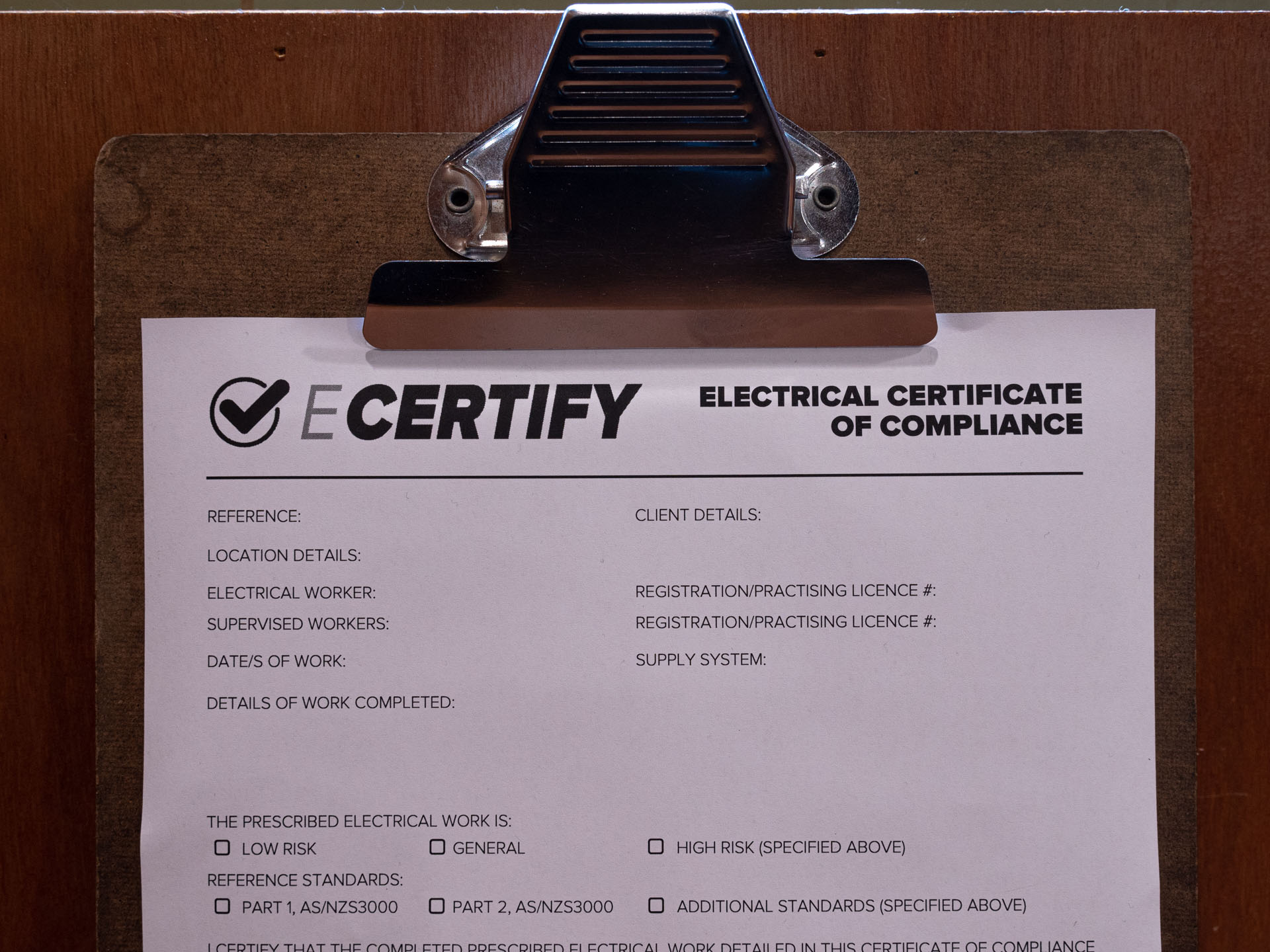
Yes, they are real. If you have a caravan, motorhome, food truck or transportable building, an electrical warrant of fitness is a legal document with a four-year life. If you meant your house, you almost certainly need something else, and eCertify can tell you which in about a minute.
eCertify works to fixed prices that include GST, so the figure quoted is the figure paid.
Get in touch today!
An electrical warrant of fitness, often written eWOF, is a real document set out in regulation 78 of the Electricity (Safety) Regulations 2010.
It applies to what the law calls a connectable installation: an electrical installation that plugs in to someone else's supply rather than being wired into a building. In plain terms, anything with a lead you connect to a power point at a campground, a depot or a site.
That covers:
The test is how it gets its power, not what it is called. An ordinary house is wired into its own supply, so it is not a connectable installation and never needs an electrical WOF. A tiny home on wheels or a relocatable dwelling that plugs in to a supply is a different matter, and usually does need one. If you are not sure which yours is, ask us. It is a quick question to answer and it is better asked than assumed.
This is where most of what you will read online is wrong.
No regulation says you must hold a current warrant simply because you own a caravan. The law puts the duty on other people, and that is what catches owners out:
So if you never plug in anywhere and never rent it out, the law does not require one of you. The moment you want to stay somewhere with power, or put it on a rental fleet, you need it.
Being honest about that is the point. eCertify would rather you booked knowing why than booked because someone implied you would be breaking the law.
Every four years. A warrant expires on the earlier of a new one being issued or four years from its date of issue.
Three things worth knowing:
This matters more on a modern motorhome than on an older caravan, and almost nobody says it out loud.
The warrant covers the 230 volt side. The connection lead and inlet, the switchboard and its protective devices, earthing and bonding, socket outlets, fixed appliances, insulation resistance and polarity testing.
The warrant does not cover your 12 volt system, your batteries, your solar, or your gas. New Zealand specifically removes those clauses from the standard the inspection is carried out to. So a warrant on a motorhome with a large lithium battery bank and rooftop solar says nothing at all about that equipment.
That is not a loophole eCertify is exploiting, it is the law, and you should know it. If you want the low voltage and solar side looked at as well, say so when you book and eCertify will quote it separately. It is a different job with a different price.
eCertify has been issuing electrical warrants of fitness for years. It is not a sideline we have just picked up, it simply was not on the website until now.
There are two prices, and the cheaper one is up to you.
| What you need | eCertify price, including GST |
|---|---|
| Electrical WOF, you bring it to us | NZ$189.90 |
| Electrical WOF, we come to you | NZ$289.90 |
Our workshop is based in Onehunga, and it is set up for inspections. A warrant done there takes a fraction of the time one done in a driveway does, and that is the whole reason the bring-it-in price is NZ$100 lower. Both figures above include GST. If the caravan is off the road, stored somewhere awkward, or you simply cannot move it, we will come to you instead.
Testing and the warrant itself are included in both. If the installation fails, you get a clear report of what needs putting right, and eCertify can quote the remedial work before anything is booked.
Anything outside a standard warrant is assessed and quoted first.
Plenty of people search for an electrical WOF because someone has asked them to prove their house is electrically safe. There is no four-yearly warrant for a house. What you need depends entirely on who asked:
Your insurance company. Usually a Certificate of Verification or an Electrical Safety Certificate, confirming the installation is safe. Insurers often write energy works certificate in the letter, which is a catch-all rather than a specific document.
Your bank or lawyer, during a sale. Usually a pre-sale Certificate of Verification.
Your council, for a building consent. Certification for the electrical work in the consent.
Your power company, after a long disconnection. If the property has been off supply for six months or more, a Certificate of Verification is needed before it can be reconnected.
Nobody, you just want to know it is safe. That is an electrical safety check, and it comes with a full written report rather than a certificate.
| What you need | eCertify price, including GST |
|---|---|
| Electrical safety check and report | NZ$249.90 |
| Pre-sale Certificate of Verification | NZ$249.90 |
| Pre-purchase electrical inspection | NZ$249.90 |
| Building consent Energy Works Certificate | NZ$259.90 |
| Insurance Energy Works Certificate | NZ$269.90 |
| Power restoration Certificate of Verification | NZ$269.90 |
| Mains work inspection and ROI, for electricians | NZ$349.90 |
eCertify is not a Metering Equipment Provider. We do not install, relocate, re-seal or inspect energy meters. That work is arranged through the property's energy retailer or its metering provider, and is inspected by a network warranted electrical inspector. If your question is about the meter itself, that is who you need, and we will point you there rather than book you in.
Hours: on-site Monday to Friday, 7am to 5pm. Enquiries any time.
Tell eCertify who has asked you for it and why. We will tell you which document it is and what it costs, before anything is booked.

787 Riddell Road, St Heliers, Auckland 1071
09 302 0884office@ecertify.co.nzFind us on Google MapsGet in touch any time. On-site work runs Monday to Friday, 7am to 5pm.
Our team are fully accredited and qualified electrical professionals.

Copyright © eCertify. All rights reserved.